Enterprise Security Platform Consolidation: A CISO Blueprint
Schedule a free consultation for enterprise security platform consolidation. Reduce tool sprawl, lower TCO, and strengthen security posture with SASE.
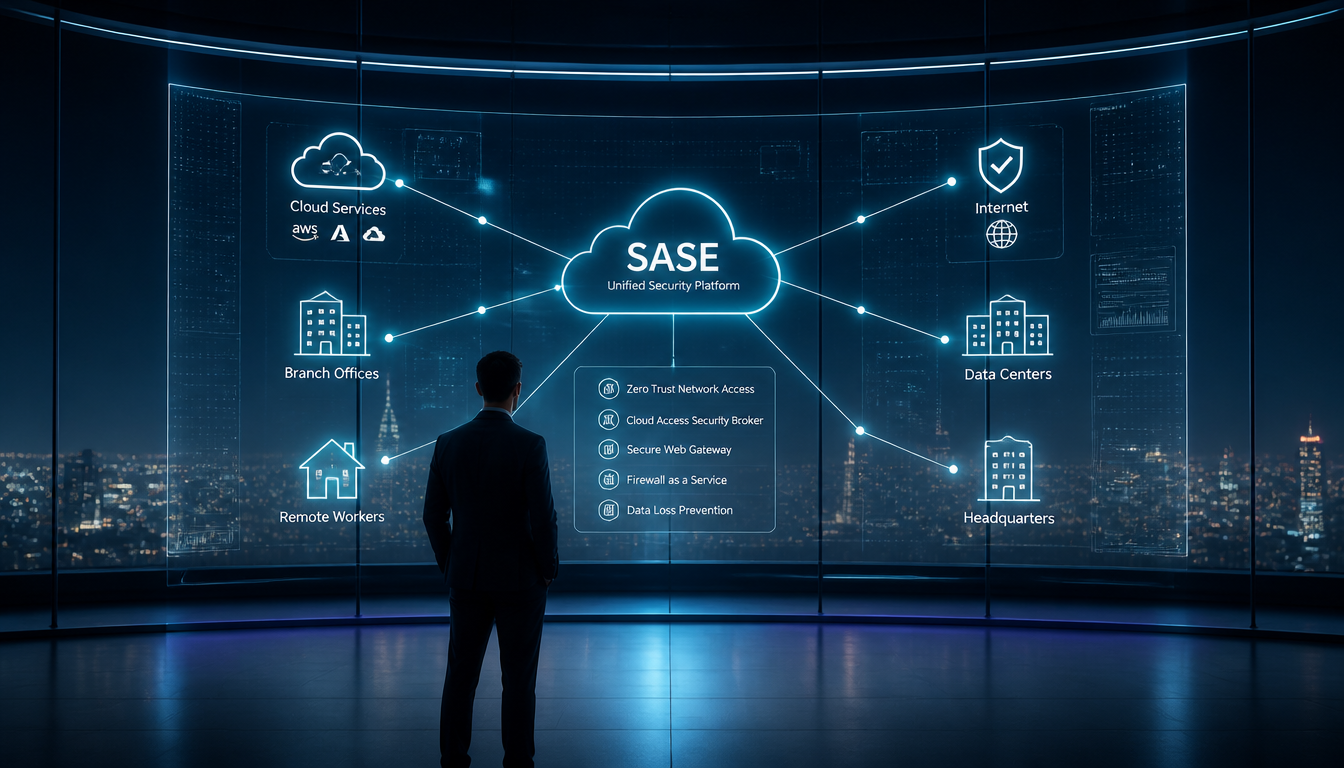
Enterprise security teams have spent years adding tools to solve discrete problems. The result is a fragmented stack: separate agents for endpoint protection, VPNs for remote access, on-premise firewalls, cloud access brokers, web gateways, email security, and identity point solutions. Each tool adds cost, complexity, and alert volume. Each integration gap becomes a potential control failure. Platform consolidation is the deliberate effort to reverse this sprawl by replacing or integrating overlapping capabilities into a coherent, cloud-native architecture. For many enterprises, the Secure Access Service Edge framework, or SASE, is the blueprint that makes this consolidation possible.
Talk with Vault Agentics about a CISO-led blueprint for enterprise security platform consolidation.
This guide is written for CISOs, security architects, and infrastructure leaders planning a consolidation program. It explains why tool sprawl accumulates, what a SASE-based target state looks like, how to design the migration, how to measure total cost of ownership, and which risks to avoid. The objective is not to advocate one vendor. It is to provide a practical blueprint for reducing complexity while improving security outcomes.
Why Enterprise Security Platforms Sprawl
Security tool sprawl typically grows from rapid digital transformation, point-solution procurement, M&A integration, and shifting work models. Each purchase solved a specific problem, but the collective architecture often lacks coordination, shared telemetry, and unified policy.
Most organizations did not set out to build twenty or thirty security products. They responded to incidents, compliance requirements, cloud migrations, and new user populations. The typical stack includes endpoint detection and response, network firewalls, secure web gateways, cloud access security brokers, data loss prevention, email security, identity providers, VPN concentrators, privileged access management, and multiple SIEM or analytics platforms. Over time, these products become difficult to staff, integrate, and optimize.
The hidden costs of fragmentation
Direct licensing is only the visible portion of the cost. Beneath it are integration work, duplicated data feeds, multiple consoles, inconsistent policy models, duplicate alerting, and the operational drag of context switching. Security analysts may investigate the same incident across three tools. Network and security teams may maintain overlapping rules in different platforms. Incident response can be delayed because no single view connects user identity, device posture, network traffic, and application access.
Why consolidation is hard to start
Consolidation requires saying no to incremental point solutions and accepting short-term disruption for long-term simplification. It also requires executive sponsorship, because teams naturally defend the tools they selected and operate. Many CISOs inherit a stack rather than design one. The first step is often an honest inventory of what exists, what it costs, and what value it actually delivers.
What Is Enterprise Security Platform Consolidation?
Enterprise security platform consolidation is the strategic reduction of overlapping security tools and the integration of remaining capabilities into a unified operating model. The goal is fewer products, shared policy, consistent telemetry, lower total cost of ownership, and stronger security posture.
Consolidation does not mean removing every specialized tool. Some capabilities, such as industrial control system security, mainframe protection, or regulated data discovery, may require dedicated products. Consolidation means eliminating redundancy, standardizing on platforms that cover multiple use cases, and integrating the rest through shared identity, telemetry, and workflow.
Consolidation is not just vendor reduction
Reducing the number of vendors can be a side effect, but it is not the goal. A single-vendor stack with poor controls can be worse than a small set of well-integrated best-of-breed tools. The real target is operational coherence: common policy language, unified visibility, automated response, and fewer places where security decisions are made in isolation.
How SASE fits the consolidation blueprint
SASE provides a reference architecture for converging networking and security into a cloud-delivered service model. It naturally replaces several legacy categories: branch VPNs, hardware firewalls, web proxies, cloud access brokers, and some data protection controls. By treating identity and context as the control points, SASE also aligns with zero trust principles and supports distributed workforces. Explore the broader Vault Agentics security services that support consolidation, architecture, and managed operations.
What Belongs in the Consolidated Target Architecture?
A consolidated enterprise security architecture typically converges secure access, network connectivity, cloud security, data protection, endpoint protection, identity, and security operations around shared identity, telemetry, and policy.
There is no universal stack. The right target depends on the organization's applications, users, locations, compliance obligations, and risk profile. The following layers are common in a SASE-centered consolidation blueprint.
Secure access and zero trust network access
Replace broad network VPNs with application-specific access based on identity, device health, and context. Zero trust network access reduces the attack surface by hiding applications from the internet and granting least-privilege access. Consolidation here often retires legacy VPN concentrators and remote access appliances.
Cloud-delivered network security
Secure web gateway, firewall as a service, and cloud access security broker functions can converge in a cloud-delivered platform. This provides consistent web and application controls for remote users, branches, and cloud workloads without backhauling traffic through on-premise data centers.
Branch and WAN connectivity
SD-WAN replaces or supplements MPLS and legacy WANs with intelligent, application-aware routing. Combined with SASE security services, it enables branches to reach cloud applications directly while maintaining consistent policy enforcement.
Endpoint and identity integration
Endpoint detection and response, device posture, and identity providers feed the SASE policy engine with real-time signals. The consolidated platform can deny or limit access when a device is unmanaged, unpatched, or shows signs of compromise.
Data protection and cloud application security
Data loss prevention, CASB, and cloud application controls can be unified to protect sensitive data across SaaS, infrastructure-as-a-service, and private applications. This reduces the need for separate DLP agents, email gateways, and cloud security point products.
Security operations and analytics
A consolidated architecture should feed a unified detection and response layer. Telemetry from access, network, endpoint, cloud, and identity should be correlated in a SIEM or security operations platform. This supports faster investigation, automated response, and continuous posture improvement. Learn more about Vault Agentics' AI-native security approach on the About page.
How to Build a CISO Blueprint for Consolidation
A CISO blueprint for consolidation includes a current-state inventory, a target architecture, a business case, a phased migration plan, governance, and metrics. It should be treated as a business transformation program, not a technology refresh.
Consolidation fails when it is treated as a procurement exercise. The following steps create a durable program that delivers cost, risk, and operational benefits.
Step 1: Inventory the current stack
Document every security tool, its owner, its use case, its cost, its data sources, its integrations, and its dependencies. Identify which tools are redundant, which are underutilized, and which are critical. Map coverage against the NIST Cybersecurity Framework or a similar model to find gaps and overlaps.
Step 2: Define the target architecture and principles
Establish architectural principles: identity-centric access, cloud-delivered controls where possible, consistent policy, shared telemetry, minimal agents, and preference for platforms that integrate across use cases. Define the SASE target state and identify which legacy tools will be retired, replaced, or retained.
Step 3: Build the business case
Quantify current spending: licenses, maintenance, support, integration labor, professional services, and the opportunity cost of analyst context switching. Estimate target-state costs, including implementation, migration overlap, training, and managed services. Tie the business case to risk reduction, compliance readiness, and operational efficiency.
Step 4: Design the migration roadmap
Sequence migrations by risk, dependency, and disruption. Start with bounded pilots, such as remote access for one division or web security for one region. Validate user experience, policy behavior, and operational workflows before expanding. Never retire a control until the replacement has proven effective.
Step 5: Establish governance and ownership
Assign owners for architecture, policy, migration, vendor management, and day-two operations. Define a change advisory process that prevents re-introduction of point solutions. Consolidate procurement review so new tools are evaluated against the target architecture.
Step 6: Define metrics and continuous improvement
Track cost reduction, tool count, policy coverage, mean time to detect and respond, user experience, security posture scores, and compliance gaps. Use metrics to justify continued investment and to identify where consolidation has created new gaps.
How to Reduce Total Cost of Ownership with SASE
SASE reduces total cost of ownership by eliminating redundant hardware and licenses, reducing network backhaul, simplifying operations, and consolidating vendor relationships. Savings are realized only when migrations are completed and old contracts are retired.
TCO improvement is the most common justification for consolidation, but it is often overstated in early business cases. Real savings require disciplined execution.
License and contract consolidation
Overlapping products frequently have overlapping licenses. A consolidated platform may cover VPN, web gateway, firewall, and CASB functions under a single contract. Capture savings by negotiating at true scale and avoiding shelfware.
Hardware and data center reduction
Cloud-delivered SASE services reduce the need for on-premise security appliances, VPN concentrators, and dedicated WAN optimization hardware. This lowers capital expenditure, rack space, power, cooling, and maintenance.
Network and backhaul optimization
With distributed users and cloud applications, backhauling all traffic to a central data center is expensive and slow. SASE allows local internet breakout with cloud-delivered inspection, reducing MPLS and private WAN costs while improving user experience.
Operational efficiency
Fewer consoles, fewer agents, and unified policy reduce the time spent on administration, troubleshooting, and incident correlation. Analysts can investigate more efficiently, and junior staff can become productive faster.
Avoiding common TCO mistakes
Do not ignore migration overlap costs, professional services, training, or the need for managed support. Do not count savings before the old tool is actually decommissioned. And do not sacrifice security effectiveness for cost reduction. A cheaper stack that misses threats is not a savings.
| Cost category | Traditional fragmented stack | SASE-consolidated target |
|---|---|---|
| Licenses | Multiple overlapping vendors | Unified platform with modular features |
| Hardware | Appliances at each site | Cloud-delivered services |
| Network | Backhaul through data center | Local internet breakout with cloud inspection |
| Operations | Multiple consoles and policies | Single policy and telemetry layer |
| Implementation | Point integrations | Integrated platform migration |
How to Strengthen Security Posture Through Consolidation
Consolidation strengthens security posture when it improves visibility, closes integration gaps, enforces consistent policy, and enables faster response. It weakens posture when it removes specialized controls without replacing their function.
Security improvement should be a deliberate outcome of consolidation, not a side effect. The following areas deserve attention.
Unified visibility
A consolidated platform provides a single view of user identity, device posture, application access, network traffic, and data movement. This makes it easier to detect anomalies, trace incidents, and prove compliance.
Consistent policy enforcement
Policy should follow the user, not the network. With SASE, the same access, data, and web controls apply whether the user is in headquarters, a branch, at home, or traveling. This reduces the inconsistent enforcement that often creates exposure.
Faster incident response
Integrated telemetry reduces the time needed to understand an attack path. Analysts can correlate an alert with the user, device, application, and network context in one investigation rather than pivoting across tools.
Reduced attack surface
Zero trust network access hides applications from the internet and replaces broad network VPNs with application-level access. Fewer exposed entry points and narrower permissions reduce the attack surface.
Maintaining specialized controls
Not every capability belongs in a single platform. Retain specialized tools where they provide unique value, such as operational technology security, fraud detection, or regulated data discovery. Integrate them into the consolidated analytics and response layer.
Common Pitfalls and How to Avoid Them
The most common consolidation failures are migrating bad policies to a new platform, retiring controls too early, ignoring user experience, choosing vendors for features rather than fit, and treating consolidation as a one-time project rather than a continuous program.
Lift-and-shift policy migration
Moving legacy firewall, VPN, and web rules into a SASE platform without review reproduces old problems. Use consolidation as an opportunity to redesign policies around current users, applications, and data.
Retiring controls before validation
Decommissioning a legacy tool before the replacement has proven effective in production creates gaps. Establish clear exit criteria and a rollback plan.
Neglecting user experience
Users will bypass controls that slow their work. Test performance, authentication, and application access from representative locations and roles. Build feedback loops and support processes.
Choosing the shiniest platform
Long feature lists do not guarantee operational fit. Evaluate providers against your use cases, identity systems, applications, and day-two workflows. A simpler platform that your team can operate is usually better than a complex one with unused features.
Stopping after rollout
Consolidation is a continuous discipline. New tools will be proposed, new applications will be adopted, and exceptions will accumulate. Maintain governance, metrics, and periodic architecture reviews to prevent sprawl from returning.
How Vault Agentics Supports Consolidation
Vault Agentics helps enterprise security teams design, implement, and operate consolidated security platforms using agentic AI, modern SASE architecture, and human security expertise.
Our teams work with CISOs to inventory the current stack, define the target architecture, build the business case, select and configure SASE platforms, migrate users and applications, and provide continuous security operations. Agentic AI accelerates telemetry analysis, policy validation, and incident triage, while human experts guide architecture, governance, and executive communication.
Schedule a free consultation to discuss your enterprise security platform consolidation roadmap.
Frequently Asked Questions About Enterprise Security Platform Consolidation
What is security platform consolidation?
Security platform consolidation is the strategic reduction of overlapping security tools and the integration of remaining capabilities into a unified operating model. The goal is lower cost, simpler operations, and stronger security.
What is SASE, and why is it relevant to consolidation?
SASE, or Secure Access Service Edge, is a cloud-native architecture that converges network connectivity and security services. It is relevant because it can replace multiple legacy tools, including VPNs, firewalls, web gateways, and cloud access brokers, with a unified platform.
Does consolidation mean using a single security vendor?
Not necessarily. Consolidation aims to reduce redundancy and improve coherence. A single-vendor platform may help, but it is not the right answer for every organization. The goal is operational integration, not vendor count alone.
How long does a consolidation program take?
Duration depends on the size of the environment, the number of tools, integration complexity, and business priorities. A typical enterprise program spans multiple quarters, beginning with inventory and pilot migrations before broad rollout.
Can consolidation reduce security risk?
Yes, when done well. Consolidation improves visibility, policy consistency, and response speed. It can reduce risk when specialized controls are preserved or replaced with equivalent or better protection.
What is the first step in a CISO consolidation blueprint?
The first step is an honest inventory of the current stack: tools, costs, owners, use cases, integrations, and coverage gaps. Without this baseline, the target architecture and business case will be speculative.