
AI-Powered SOC: 5 Questions Before Production
Ask these five AI-powered SOC questions before production. Set authority, evidence, reversibility, escalation, and who signs the go-live gate.
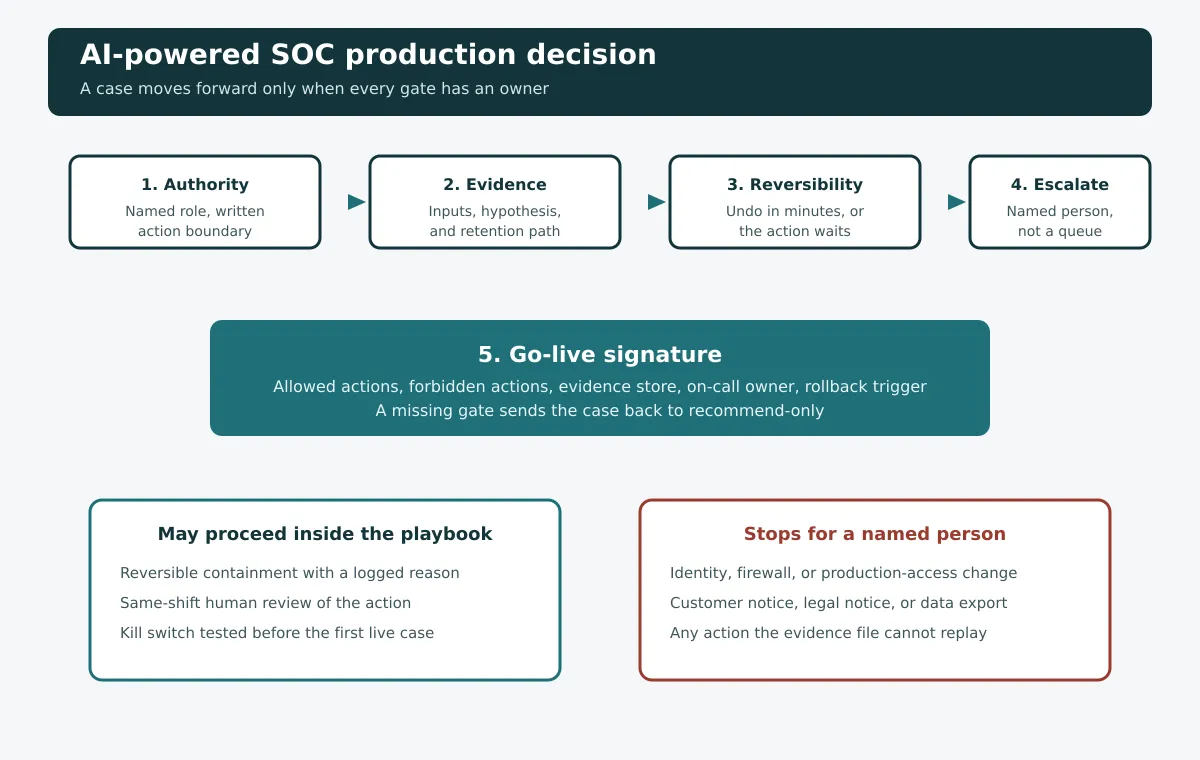
An AI-powered SOC that can close alerts is not ready for production until a named person can stop it, explain it, and reverse it. Security leaders are being sold machine-speed triage while their teams still own the breach, the customer call, and the audit. The decision in front of you is not whether AI can read an alert. It is which actions that system may take on a live identity, a live endpoint, or a live control before a human sees the case.
Book a 10-minute intro call before an AI-powered SOC takes a production action.
Vault Agentics builds that line with hardware-accelerated AI security and human experts, not with a promise that the model will be careful. On the live agents page, every agent works inside limits the customer sets. Every action is logged, and any agent can be stopped in one click. That is the standard a production decision should meet. The AI-native SOC coverage page shows how enrichment and triage replace tier-1 toil. This page is the question set that has to be answered before that model is allowed to act.
What Must an AI-Powered SOC Prove Before It Acts?
An AI-powered SOC earns production access only after leadership can name the action, the owner, the evidence, and the undo. Speed is not the proof. A closed ticket is not the proof. The proof is a record a CISO, an MSSP customer, or an assessor can read after the fact and still defend.
NIST treats this as governance, not as a feature checklist. The NIST AI Risk Management Framework Core organizes risk work into Govern, Map, Measure, and Manage, and it says governance cuts across the other three. The Govern playbook asks for policies that are implemented, transparent, and effective, not a slide that says a human remains in the loop. If the policy cannot be pointed to in the workflow, it is not a control.
Cloud Security Alliance research on the AI SOC investment paradox draws the same line from the other direction. An agent that quarantines an endpoint, blocks traffic, disables an account, or changes a firewall rule is taking an organizational action. A drafting assistant that writes a note is not. Those two systems do not share an approval model, and they should not share a go-live meeting.
Use five questions. If any answer is "the vendor handles that," the system is still a pilot.
- Who may authorize a production action, and which actions are forbidden even with a high score?
- What evidence must exist before the action, and where is it stored?
- Which actions are reversible in minutes, and which ones require a person?
- When does the case leave the model and reach a named human?
- Who signs the go-live decision, and what metric can force a rollback?
Who Holds Authority When the Model Is Confident?
Authority in an AI-powered SOC is a named role with a written boundary, not a confidence score. A model can be right about a pattern and still be the wrong actor for the change. The person who accepts risk for the business remains the person who accepts risk for the action.
Split the work before you split the tooling. Investigation can be broad. Action must be narrow. A useful split for a mid-market team, or an MSSP running customer environments, looks like this.
| Decision | AI-powered SOC may do | A named human must do |
|---|---|---|
| Triage and enrichment. | Attach identity, asset, and prior-case context, then rank the alert. | Set the sources the model is allowed to read. |
| Reversible containment. | Isolate a device or pause a token inside a pre-approved playbook. | Review the action log the same shift. |
| Identity change. | Recommend a disable or a privilege cut. | Approve it, because the business impact is not in the alert. |
| Control change. | Draft the rule and the rollback. | Apply anything that touches firewall, email, or production access. |
| Customer or legal notice. | Assemble the timeline. | Decide what is said, and to whom. |
The same boundary already shows up in how Vault Agentics describes its own agents. The agents page says Val routes work and needs a person for the final sign-off on a commitment. Zang can show where data is at risk and draft a fix, and it does not shut systems down on its own. Neither is a silent operator. The production rule is the same: the agent proposes, the written boundary decides, and a person owns the exception.
MSSPs should write the boundary into the customer agreement, not only into the console. A reseller who operates an AI-powered SOC under another brand still owns the action the customer will ask about. The partner program is built so that customer relationship stays with the partner. The operating limit should stay just as visible.
Identity governance is the control that makes the boundary real. If the agent identity can reach more systems than the playbook names, the playbook is fiction. Map the agent the way you map a privileged user: what it can open, what it can change, and who can revoke it before the next case.
What Evidence Must Exist Before Go-Live?
Evidence is the case file the AI-powered SOC writes before it acts, and the file an outsider can replay later. Without that file, a fast close is an unowned change. With it, a wrong close is a finding you can correct.
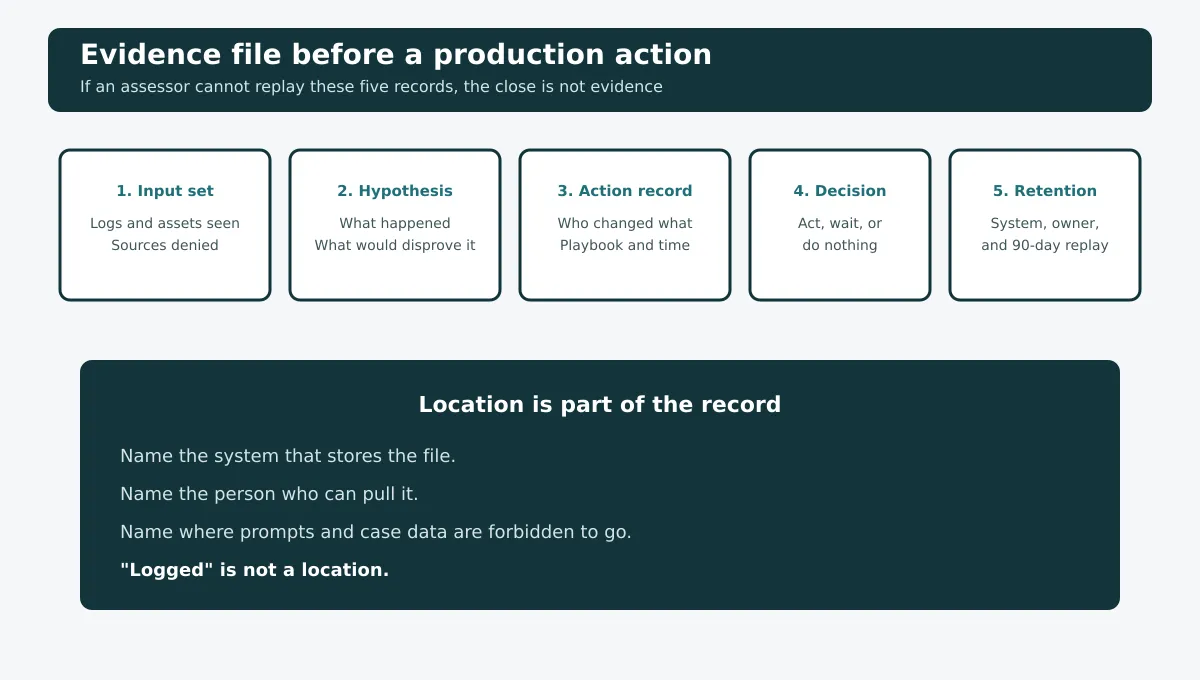
Ask for five artifacts on a real alert, not on a demo tenant.
- Input set: which logs, identities, and assets the model saw, and which it was denied.
- Hypothesis: what it thought happened, and what evidence would disprove that.
- Action record: who or what changed the control, at what time, and under which playbook.
- Human decision, including the decision to do nothing.
- Retention path, so an assessor can pull the same record in 90 days.
A November 2026 Cloud Security Alliance roundtable on the AI-driven SOC reported two staffing facts. The roundtable reported that 40 to 42 percent of security alerts go uninvestigated, and that more than half of cybersecurity teams are understaffed. That gap is why leaders buy automation. It is also why "the model looked at it" is not evidence. An uninvestigated alert that an agent closed still needs a reason code, a data source, and a way to reopen the case.
Defense manufacturers should treat this file as controlled work product. Defense engagements start by showing where controlled data is going, then setting limits. An AI-powered SOC that copies case data into a consumer model fails that test before it fails a detection test. So does one that stores prompts outside the enclave. Regulated mid-market teams should ask the same question even when CMMC is not the driver. If you cannot show where the case file lives, you cannot show who can read it.
The Trust Center is the public version of this habit. Security, compliance, insurance, and incident response are stated where a buyer can check them. Your SOC evidence standard should be just as specific. "Logged" is not a location. Name the system, the owner, and the retention clock.
Which Actions Stay Reversible, and Which Wait?
Reversibility is the production gate for an AI-powered SOC. If the business can undo the action in minutes without a customer apology, the action can be a candidate for automation. If the undo is a restore, a legal notice, or a lost deal, the action waits.
Write the line in the playbook, not in a principle document. A device isolation that expires, a token pause, or a temporary block on a known-bad destination can be reversible. Disabling a payroll administrator, blackholing a partner domain, or wiping an endpoint is not reversible in any sense a customer will accept. The model does not get to discover that difference during an incident.
Cloud Security Alliance's agentic-SOC research is blunt about why the line matters. The 2026 CrowdStrike figure cited there puts average eCrime breakout time at 29 minutes. Machine-speed investigation is the point. Machine-speed destruction is the failure mode. The design that survives both facts is a short list of pre-approved, reversible actions and a hard stop on everything else.
- List every action the platform can take in the customer environment.
- Mark each one reversible, reversible with effort, or irreversible.
- Allow automation only for the reversible set, and only inside a named playbook.
- Require a same-shift human review of every automated action, even the ones that were allowed.
- Put a kill switch on the agent identity, and test it before go-live.
Vault Agentics treats that stop as a product fact, not a slogan. The agents page states that you can stop any agent in one click, and that nothing runs until you approve it. A production SOC should be able to say the same sentence about its own automation. If the only stop is a support ticket to the vendor, you do not have a kill switch.
For a team that wants to see the pattern on its own AI use before it redesigns the SOC, the Free AI Map shows where agents and data already move. A 14-day trial is the smaller step when the question is whether bounded agents fit the current stack. Neither replaces the go-live review. Both keep the first look inside limits you set.
When Does a Case Leave the Model?
Escalation is a rule with a clock, not a hope that an analyst will notice. An AI-powered SOC that never escalates is hiding work. One that escalates everything has only added a narrator to the queue.
Set the handoff on facts a reviewer can audit. Escalate when the action is outside the reversible list. Escalate when the asset is a crown-jewel system, a privileged identity, or a customer-facing service. Escalate when two sources disagree.
Escalate when confidence is high but business context is missing. That is the usual case for a vendor email, a plant-floor device, or a defense program. Escalate when the same playbook has fired too often in one shift. Volume means the rule is wrong, not that the model is thriving.
Name the person, not the queue. "Tier 2" is not an owner at 2 a.m. A company of 10 to 200 people often has one security lead and a managed partner. That lead should see the exception, not the full alert firehose. An MSSP should show the customer which exceptions stay with the partner and which ones wake the customer's own approver. Incident response tools matter here only as the place the handoff is recorded. The tool does not create the duty to escalate.
The CSA roundtable's staffing point belongs in this design. Teams with open roles cannot review every alert, and they should not pretend they will. They can review every action that changes a control, and every case the rule set refuses to close. That is a smaller promise, and it is one an understaffed team can keep. In-house and outsourced SOC models are a separate choice about who sits in the seat. The escalation rule has to exist either way.
How Should Leadership Sign the Go-Live Decision?
Go-live is a signed decision with a rollback test, not a feature flag a project manager flips on Friday. The signer should be the person who will explain the first bad action to the board, the customer, or the contracting officer.
Hold the review to one page. State the actions now allowed, and the actions still forbidden. Name the evidence store, the retention clock, the on-call human, and the backup.
Show one week of pilot data. Count alerts closed, cases escalated, automated actions a human reversed, and minutes the kill switch took in a drill. If the pilot cannot produce those four numbers, it is a demo.
NIST's point that risk management continues across the lifecycle is the second half of the signature. Go-live is not the end of Govern. Add a rollback trigger in the same meeting. A practical trigger is a reversed action rate, a repeated bad containment, or a case the evidence file cannot replay. When the trigger hits, automation drops back to recommend-only until the same signer restores it. That is Measure and Manage, applied to a SOC instead of left in a framework poster.
Bring the action list to a scoping conversation before the model is allowed to change a control. The public engagements page is the place to compare how hands-on work is scoped. Do not treat a vendor slide as the signature. The architecture behind a human-governed model is covered in agentic SOC architecture. This signature is what lets that architecture touch production.
Leaders who want a second set of eyes on the control design can start with AI security consulting or a vCISO strategy review. Skip the tool tour. The question to bring is simple. Which production action is still waiting for a name?
Schedule the intro call and bring the action list you are about to allow.
Frequently Asked Questions
What should leadership ask before an AI-powered SOC goes to production?
Ask who may authorize a live action, and what evidence is stored before it. Ask which actions are reversible, when a named person must take the case, and who can roll automation back to recommend-only. If any answer is a vendor slogan, the system is still a pilot.
Does a human have to approve every alert an AI-powered SOC closes?
No. A human has to approve the action boundary, and a human has to review every action that changes a control. Closing a low-risk, well-evidenced alert inside that boundary is the work automation should take. Changing an identity, a firewall rule, or a customer notice is not.
How is this different from buying an AI assistant for analysts?
An assistant drafts. An AI-powered SOC that quarantines a device, disables an account, or pushes a block is acting for the organization. Cloud Security Alliance research treats those actions as audit and accountability events, not as assistant output. The approval model has to match the action, not the marketing tier.
What evidence will an assessor or a customer expect?
Expect the input set, the hypothesis, the action record, the human decision, and a retention path that still works months later. "The model logged it" is not a location. Name the system, the owner, and the clock. Defense and other regulated teams should also name where prompts and case data are forbidden to go.
Who should sign the go-live, the CISO or the MSSP?
The signer is the person who will explain the first bad action. In a direct engagement, that is usually the customer's security leader. In a partner-operated SOC, name the customer approver for irreversible actions in the agreement. Vault Agentics keeps that customer relationship with the partner when the partner owns it.