
"AI Export Controls: Security Governance Brief"
"AI export controls demand governance for cross-border access, compute, model supply chains, data handling, third parties, documentation, and exceptions."
AI export controls have become a security governance issue for every enterprise that moves compute, model artifacts, software, technical assistance, or sensitive data across jurisdictions. A cloud region, model API, remote administrator, reseller, or fine-tuning workflow can create a cross-border decision that no longer fits inside a traditional shipping checklist.
Security and technology leaders need an operating model that turns changing rules into controlled decisions. This briefing maps the control points across access governance, compute and model supply-chain visibility, data handling, third-party providers, documentation, exception management, and executive coordination. It is an operational guide, not legal advice. Export-control classification, licensing, and jurisdictional conclusions require qualified counsel and the relevant authority.
Schedule a security governance conversation for your cross-border AI operations.
Why AI export controls belong in security governance
AI export controls are a security governance problem because the controlled activity may be an access path, service relationship, software transfer, or technical interaction rather than a physical shipment. That makes the security organization part of the control environment. Identity systems, cloud policy engines, data-loss controls, supplier records, logging, and incident response all influence whether an organization can explain who accessed what, from where, for which end use, and under whose authority.
The policy environment also changes faster than a static annual compliance review. The U.S. Bureau of Industry and Security announced the rescission of the Biden-era Artificial Intelligence Diffusion Rule in May 2025, while stating that a replacement rule would follow. In May 2026, BIS issued guidance clarifying that certain pre-existing license requirements for advanced computing items still apply to entities headquartered in Country Group D:5 or Macau, including certain entities located outside those destinations. The lesson is not that one announcement resolves an enterprise's obligations. The lesson is that governance must record the rule version, decision date, authority, and trigger for reassessment.
Jurisdictional coverage is also broader than the United States. The European Commission describes controls on the export, transit, brokering, and technical assistance of dual-use items under Regulation (EU) 2021/821. The United Kingdom updated its dual-use control framework in 2025, including controls for emerging technologies. An enterprise that treats export control as a single-country screening task will miss the points where a provider, employee, reseller, or technical support team creates a separate obligation.
Vault Agentics frames this problem as a security transformation challenge: the organization needs one decision system that connects strategy, architecture, implementation, and ongoing operations. That model is relevant when leaders need to consolidate fragmented controls into a working program rather than add another disconnected tool. The compliance trust center is another useful internal reference point for connecting governance claims to evidence.
What should an enterprise inventory before approving cross-border AI?
An enterprise AI inventory must track the full chain of capability, access, data, and parties involved in a cross-border operation. A list of servers and software licenses is not enough. The decision record should show how an AI capability is created, hosted, transferred, accessed, supported, and retired.
Start with the capability itself. Record the model family, version, weights or other deployable artifacts, fine-tuning files, inference endpoints, training code, evaluation tools, embedded libraries, and hardware dependencies. Classify where each item originated, where it is stored, where it is processed, and which users or services can retrieve it. The record should distinguish a public API call from a transfer of model weights, because they present different technical and governance questions.
Next, map the operational path. Capture the cloud account, region, availability zone when material, network path, storage location, backup location, support location, and administrative access path. Add the data categories entering prompts, training jobs, logs, telemetry, and support tickets. A data flow map should include temporary copies and derived artifacts, not only the system of record.

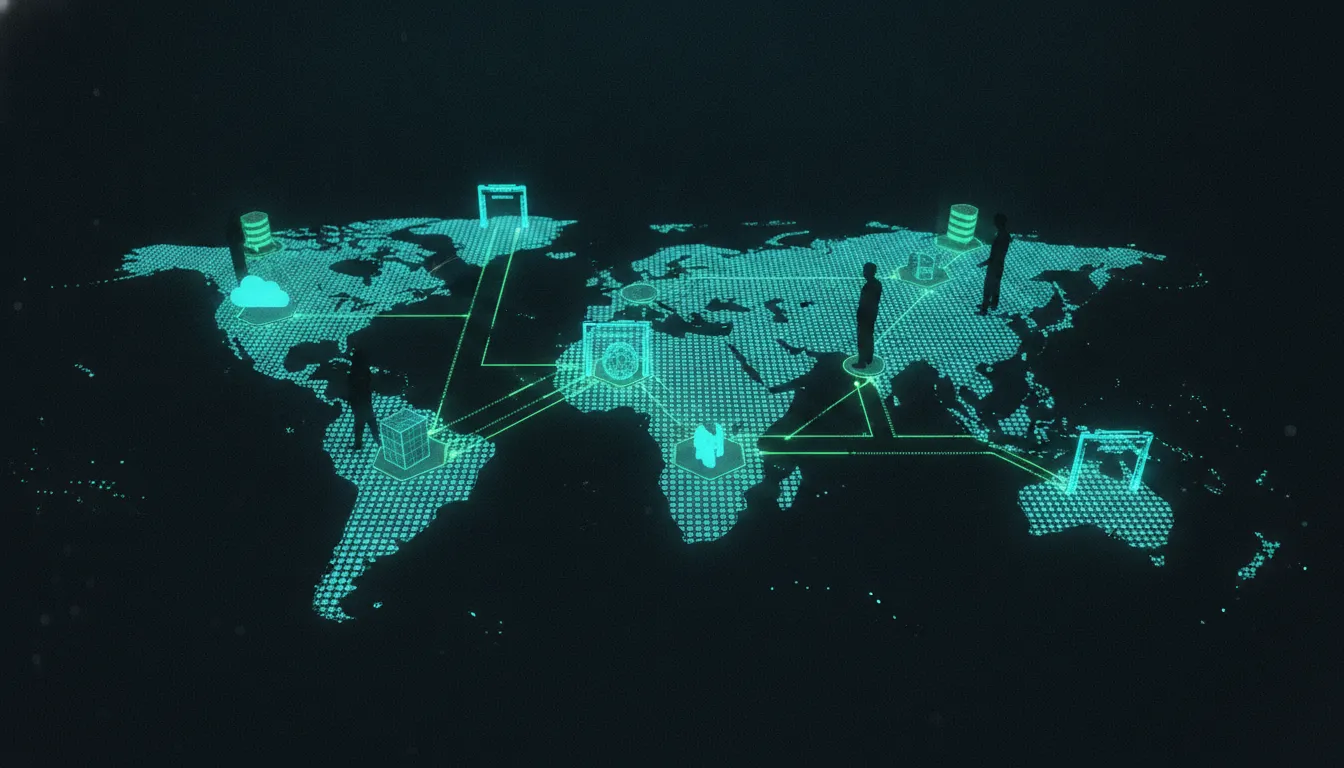
Model artifacts, compute, software dependencies, and provider access should share one provenance record.
Finally, identify the parties and intended use. Record the exporter, purchaser, provider, reseller, intermediate consignee, ultimate consignee, end user, parent ownership, and destination. Record the stated end use in business terms that an engineer, procurement lead, and lawyer can evaluate. BIS guidance emphasizes knowing the customer and parties that facilitate an export. A governance inventory should therefore treat the customer record as a security object, not a sales-only field.
- Capability: model, weights, hardware, software, service, or technical assistance.
- Location: origin, processing region, storage, backup, support, and destination.
- Access: human, service account, AI agent, administrator, reseller, or subcontractor.
- Data: prompts, training data, model context, logs, credentials, and derived artifacts.
- Parties: customer, parent company, consignee, provider, broker, and end user.
- Decision: classification, screening outcome, authorization, exception, owner, and review date.
This inventory is deliberately broader than the supplier assessment covered in Vault Agentics' AI supply-chain risk management briefing. That article remains the right destination for vendor and component risk. This briefing reserves the cross-border decision layer, where provenance and party data become inputs to access and transaction controls.
How should access governance enforce destination and end use?
Access governance is the enforcement layer that turns export-control decisions into runtime behavior. A policy that lives only in a contract or spreadsheet cannot prevent an unauthorized administrator from downloading a model artifact, changing a cloud region, granting API access, or routing support activity through an unapproved party.
Build policy around the combination of identity, capability, destination, end use, and time. A user or service account should not receive access to a sensitive model or advanced compute pool based only on a group membership. The authorization decision should evaluate the person's role, organization, location, approved project, destination, artifact classification, provider, and current exception state. The same control should cover AI agents and automation accounts, because machine identities can create transfers at a higher volume than human operators.
Use least privilege for artifacts and operations. Separate permissions to view model metadata, retrieve weights, submit inference jobs, change deployment regions, administer cloud resources, and provide technical support. Require step-up approval for high-risk actions such as export of an artifact, activation of a new destination, or access by a third-party support team. Enforce separation of duties so the person who requests a destination change cannot approve it alone.
Identity, destination, end use, and exception status should be evaluated together.
Screening is necessary but not sufficient. BIS states that restricted-party requirements can apply when a listed party is a party to the transaction, including an applicant, purchaser, or consignee. BIS also describes red flags that require inquiry and reevaluation. Build those signals into the workflow: an end use that does not fit the buyer's business, an unexplained intermediary, a destination that conflicts with the stated use, a request to bypass normal installation or support, or a sudden change in ownership should stop an automated approval.
The runtime control should fail closed for unresolved signals, but it should also provide a documented path to review. Security teams can monitor policy decisions, failed requests, attempted region changes, privileged access, and artifact downloads. The broader enterprise browser security strategy provides a useful adjacent model for governing identity, sessions, and sensitive data at the point of use. The enterprise AI risk assessment framework provides the broader risk context. Neither replaces the export-control decision record.
Get a security architecture review for the identities, cloud controls, and AI workflows in scope.
How do third-party providers change the control boundary?
Third-party providers extend the control boundary into infrastructure, software, data processing, support, resale, and subcontracting relationships. A company may approve one provider while an unseen subprocessor, support engineer, cloud region, or reseller performs the actual activity that changes the risk.
Procurement should require a provider record that security can enforce. At minimum, capture the legal entity, parent ownership, service locations, subprocessor list, support locations, data and artifact handling, customer segregation, model and compute dependencies, access roles, logging commitments, and notice process for material changes. Add contract terms for end-use restrictions, destination controls, flow-down obligations, no unauthorized reexport, audit cooperation, evidence retention, incident notification, and suspension rights.
The technical design should make provider assertions testable. A vendor questionnaire that says data is handled in an approved region is not equivalent to a control that blocks an unapproved region. Require region-aware deployment policies, immutable audit logs, exportable access records, artifact checksums, provider identity federation, and a mechanism to revoke access when an authorization expires. Test the control with a provider change, not only with a green-path deployment.
NIST's AI Risk Management Framework calls for documented policies that address AI risks from third-party entities and supply-chain issues. NIST SP 800-161 Rev. 1 also places cybersecurity supply-chain risk management across information security, privacy, system development, acquisition, procurement, legal, and human resources. Those are useful governance anchors because export-control decisions are rarely owned by one department.
Use a risk-tiered provider model:
- Strategic compute or model provider: requires full provenance, destination, support, and change-management evidence.
- Data or integration provider: requires data-flow mapping, subprocessor visibility, retention controls, and transfer restrictions.
- Reseller or intermediary: requires end-user evidence, ownership checks, flow-down terms, and a clear responsibility boundary.
- Technical support provider: requires privileged-access controls, personnel location records, session logging, and time-bound access.
Keep this control layer distinct from generic third-party risk. Vault Agentics' third-party AI risk article addresses the wider supply-chain problem. The export-control addition is a transaction-aware provider map that can answer whether a specific person, service, artifact, and destination are authorized together.
What should documentation and exception management look like?
Documentation and exception management create the evidence trail that allows an enterprise to defend a decision, reproduce it, and change it when the facts change. The objective is not to create paperwork for its own sake. The objective is to preserve the inputs, authority, controls, and approvals behind a cross-border AI action.
Use one record for each material capability or transaction, with links to the relevant system logs and source documents. The record should include the item or service description, origin, classification analysis, destination, end user, ultimate parent, stated end use, provider chain, screening results, red-flag assessment, authorization or license basis, applicable exception, decision owner, approval timestamp, expiry date, and reassessment trigger. If a conclusion is uncertain, record the uncertainty and route it to legal review instead of converting an unresolved question into an informal approval.
Exceptions should be narrow, time-bound, and conditional. Define exactly what is allowed, for which capability, to which party, in which location, for what duration, and under which safeguards. Require a named business owner and security owner. Add automated expiry, review reminders, download limits, session recording where appropriate, and a kill switch. A permanent exception is usually an undocumented policy change, not an exception.

Exception decisions need named owners, conditions, expiration, and evidence.
BIS's Know Your Customer guidance describes a practical sequence for red flags: identify abnormal circumstances, inquire, reevaluate the information, and refrain from the transaction or contact BIS when concerns remain. An enterprise can operationalize that sequence without pretending that a security workflow makes the legal determination. The workflow should preserve the question asked, the answer received, the documents reviewed, the person who evaluated the response, and the reason the transaction proceeded or stopped.
Evidence should be machine-readable where possible. Link identity events to policy decisions, policy decisions to approvals, approvals to transactions, and transactions to artifacts or service tickets. Monitor for drift between the approved record and live conditions. A provider region change, model version change, parent-company acquisition, new end use, or new support location should reopen the decision.
Vault Agentics' automated compliance evidence collection workflow is a relevant adjacent pattern for reducing manual evidence work. The CISO risk assessment checklist can help connect the export-control record to broader enterprise risk. The control remains credible only when the evidence reflects the actual environment.
How should security, legal, procurement, and executives coordinate?
Cross-border AI decisions require a defined operating model because no single function owns all of the facts. Legal may interpret a jurisdiction or authorization question, but security controls the identities and logs. Procurement sees provider terms and ownership changes, but engineering sees the actual deployment path. Executives set risk appetite and resource priorities, but they should not approve from a summary that hides unresolved control gaps.
Assign clear responsibilities before a high-risk transaction appears. Security should own control architecture, identity enforcement, logging, monitoring, and incident escalation. Legal or export counsel should own legal interpretation, classification advice, license analysis, and regulatory watch. Procurement should own provider due diligence, flow-down terms, change notices, and evidence requests. Engineering and cloud teams should own technical inventories, deployment boundaries, artifact integrity, and region controls. The executive sponsor should accept business risk only when the decision packet states the residual risk, compensating controls, duration, and exit plan.
Use a decision forum for material changes rather than a standing committee that reviews every low-risk action. A trigger should include a new destination, new model or compute class, new provider or reseller, change in ownership, unusual end use, material support access, or a red flag that cannot be resolved by the operating team. The forum should produce a short, structured decision record. Meeting minutes alone are not enough if they do not map the decision to an enforceable control.
Executives should receive metrics that show control performance, not just the number of policies published. Useful measures include the percentage of in-scope AI assets with a current owner, the percentage of providers with verified subprocessor data, median exception age, expired exceptions still active, unresolved red flags, unreviewed region changes, privileged sessions outside approved windows, and the time from a regulatory change to updated policy enforcement.
This cross-functional model supports Vault Agentics' operator-led security positioning because it connects executive strategy to architecture and ongoing operations. It also creates a natural handoff into advisory and strategy when a CISO needs a board-ready roadmap, an architecture decision, or an implementation plan rather than another disconnected assessment.
A 90-day operating sequence for security leaders
A 90-day operating sequence gives security leaders a bounded way to move from policy uncertainty to controlled execution without claiming that a short project resolves every legal question. The sequence should produce a decision system, a prioritized control backlog, and evidence that the controls work in the environments where AI is actually used.
Days 0-30: establish the decision boundary. Name the executive sponsor, legal or export counsel, security owner, procurement owner, and technical owners. Inventory models, compute, APIs, data flows, providers, personnel access, destinations, and end uses. Identify the highest-consequence artifacts and transactions. Record which facts are known, which are missing, and which decisions require legal advice. Review the current BIS, EU, UK, and other relevant authority sources through an owned regulatory watch process.
Days 31-60: implement the control path. Connect identity, cloud policy, provider records, screening, approval, and evidence systems. Build a policy decision point for new destinations, artifact access, privileged support, and provider changes. Create a red-flag workflow with a stop state and an escalation owner. Pilot the workflow on one model, one compute environment, one provider chain, and one cross-border use case. Test both approved and denied paths.
Days 61-90: test, measure, and operationalize. Run tabletop scenarios for a new parent company, a changed cloud region, an expired exception, an unexpected support location, and a model artifact download. Reconcile records against access logs. Close gaps in contracts and inventory. Set the review cadence and metrics. Publish an executive decision pack that separates legal conclusions from technical evidence and clearly identifies unresolved work.
The outcome should be a living control plane, not a static policy PDF. It should tell a security operator what to block, an engineer what to configure, procurement what to ask, legal what facts to review, and an executive what risk remains. Organizations that need help connecting those workstreams can contact Vault Agentics to discuss advisory, architecture, implementation, and managed security options.
Request a cross-border AI security governance assessment.
Frequently asked questions about AI export controls
Complex AI export-control questions require a fact pattern, an authority check, and a control decision rather than a one-line rule summary. These answers describe governance considerations and do not replace qualified legal advice.
How should a company govern API access when the model provider and end user are in different jurisdictions?
The company should treat the API, identity, data, provider, destination, and stated end use as one decision record. An API request may not be equivalent to a transfer of model weights, but it can still expose controlled data, technical assistance, or capabilities that require review. The organization should document the provider's service locations, support access, subprocessor chain, user and parent identity, data categories, applicable authorization basis, and runtime controls. Security should enforce the approved path, while legal or export counsel determines how the facts map to applicable rules. A region selector alone is not proof that the full service relationship is authorized.
What evidence should be retained when an AI transaction is not obviously controlled?
Retain the facts that support the decision, not only the conclusion. That includes the item or service description, origin, classification analysis, destination, parties, end use, provider information, screening result, red-flag review, relevant authority version, approval owner, date, and linked system evidence. If the decision relies on a customer representation or provider statement, retain the source and its scope. A future review should be able to reproduce what was known at the time and see what would trigger reassessment. Record uncertainty explicitly instead of relying on an undocumented assumption that the transaction is outside scope.
How should exceptions be handled when a cloud provider changes regions or subprocessors?
A material region or subprocessor change should trigger a reassessment before the changed path becomes available. The exception record should name the approved provider configuration, location, service, data or artifact scope, safeguards, expiration, and owner. Provider change notices should feed a workflow that pauses or limits access until the new facts are reviewed. Security can compare provider assertions with deployment configuration, identity events, and network telemetry. Procurement should preserve contract and subprocessor evidence, while legal or export counsel determines whether the change affects classification, destination, end use, or authorization.
How can U.S., EU, and UK export-control programs be coordinated without assuming they are interchangeable?
Coordinate them through a common fact and evidence model, not through a single universal rule table. Maintain jurisdiction-specific logic for definitions, lists, authorizations, end-use controls, technical assistance, brokering, and recordkeeping. Then connect each decision to the jurisdictions, parties, assets, and activity actually in scope. A common governance workflow can route the same transaction to the appropriate authority owners, but it should preserve separate legal conclusions and review dates. Regulatory watch, change impact analysis, provider controls, and access enforcement should be shared where practical, while classification and licensing decisions remain jurisdiction-specific.
Government sources for ongoing review
Government sources anchor the operating model because AI export-control requirements and guidance change over time. Security leaders should verify the current text and seek qualified advice before relying on any source for a transaction decision.
- BIS announcement on the rescission of the AI Diffusion Rule.
- BIS May 31, 2026 guidance on advanced computing items and D:5 or Macau-headquartered entities.
- BIS Know Your Customer Guidance and Red Flags.
- BIS Export Compliance Guidelines.
- European Commission overview of exporting dual-use items.
- EUR-Lex consolidated Regulation (EU) 2021/821.
- UK Export Control Joint Unit Notice to Exporters 2025/30.
- NIST Artificial Intelligence Risk Management Framework.
- NIST SP 800-161 Rev. 1, Cybersecurity Supply Chain Risk Management.
About Vault Agentics
Vault Agentics is an AI-native cybersecurity firm serving enterprise and mid-market organizations, with a focus on regulated sectors including the defense industrial base. The firm provides advisory and strategy, security architecture and design, implementation and migration, and managed agentic services, and is a Palo Alto Networks NextWave Solution Provider. Vault Agentics is headquartered in Orange County, California. Website: vaultagentics.com. Podcast: youtube.com/@VaultAgentics.
Hani Braish is Founder and Chief Executive Officer of Vault Agentics. He built his career in go-to-market and growth roles across enterprise networking, security and cloud at General Electric, Cisco Systems and Palo Alto Networks, has scaled businesses large and small, and worked with government and ministry customers across the Middle East and Africa. He has lived and worked in more than 15 cities. He is the author of the Vault Airport Framework and hosts the Vault Agentics channel on YouTube, interviewing chief information security officers, founders and operators.
Media contact
Hani Braish, Founder and Chief Executive Officer · hbraish@vaultagentics.com · +1 949-300-8882